

Businesses today need more than a website and occasional social media posts to compete for attention. Customers search online, compare options, read reviews, visit websites, and make decisions across multiple digital channels. For businesses operating in a competitive market, having a clear and connected digital marketing strategy can make that customer journey easier to manage.
This is where San Diego digital marketing becomes especially relevant for local businesses that want to improve visibility, attract qualified prospects, and create a stronger path from online discovery to conversion.
San Diego has a diverse business environment that includes technology, life sciences, tourism, manufacturing, international trade, and other industries. The City of San Diego also provides business resources focused on research, marketing, expansion, and entrepreneurship.
Whether a company is building its first serious online strategy or improving an existing one, the goal should not simply be to generate more clicks. The goal is to create a digital system that connects visibility, engagement, leads, and measurable business outcomes.
What Is San Diego Digital Marketing?
San Diego digital marketing refers to the use of online channels and strategies to help businesses reach potential customers, communicate their value, generate leads, and support sales.
Depending on the business, a digital strategy may include:
- Search engine optimization
- Google Ads and paid search
- Social media advertising
- Website development
- Content marketing
- Email marketing
- SMS marketing
- Branding and creative services
- CRM and marketing automation
- Analytics and performance tracking
- Artificial intelligence and automated customer engagement
The important point is that these channels should not operate independently.
For example, a business may use SEO to attract people searching for information, paid advertising to reach high-intent prospects, a conversion-focused website to capture leads, and automation to follow up with those leads.
When these activities are connected, businesses can create a more consistent customer journey.
Why Digital Marketing Matters for San Diego Businesses
San Diego has a broad and active business ecosystem. The City of San Diego notes that the region has a strong concentration of high-tech companies and a large small-business community.
That environment creates opportunities, but it also means businesses need to communicate clearly with their intended audiences.
A potential customer may discover a company through Google, see an advertisement on social media, visit the website later, and then return through a branded search before contacting the business.
If each channel communicates a different message, the customer experience can become confusing.
A connected strategy helps businesses maintain consistency across their digital presence.
Instead of asking, “How can we get more traffic?” a better question is:
“How can we turn relevant online attention into measurable business opportunities?”
That shift helps businesses focus on outcomes rather than vanity metrics.
SEO: Building Long-Term Search Visibility
Search engine optimization is one of the most important parts of a sustainable digital marketing strategy.
SEO helps businesses improve their visibility when potential customers search for relevant products, services, questions, or solutions.
A practical SEO strategy can include:
- Keyword research
- Search intent analysis
- Technical website improvements
- On-page optimization
- Useful content creation
- Internal linking
- Local search optimization
- Conversion-focused landing pages
- Performance measurement
For a local company, this may include creating content around relevant services and geographic search intent.
However, effective SEO should not mean filling pages with the same keyword repeatedly.
For example, a page targeting san diego digital marketing should naturally explain digital marketing concepts, services, customer needs, and local business considerations. Search engines and readers both benefit from content that clearly answers the underlying question.
The strongest SEO strategy is therefore built around usefulness, relevance, structure, and a clear customer journey.
Paid Advertising Can Capture High-Intent Demand
SEO can support long-term visibility, while paid advertising can help businesses reach specific audiences more immediately.
Paid search allows businesses to place offers in front of people actively searching for relevant solutions. Social advertising can provide another way to reach potential customers based on audience characteristics and campaign objectives.
A successful paid advertising strategy requires more than launching advertisements.
Businesses need to consider:
- The target audience
- The offer
- The advertisement
- The landing page
- The conversion action
- The follow-up process
- The measurement system
If an advertisement attracts visitors but the landing page does not clearly explain what happens next, the campaign may struggle to produce meaningful results.
This is why advertising should be treated as part of a larger funnel rather than an isolated activity.
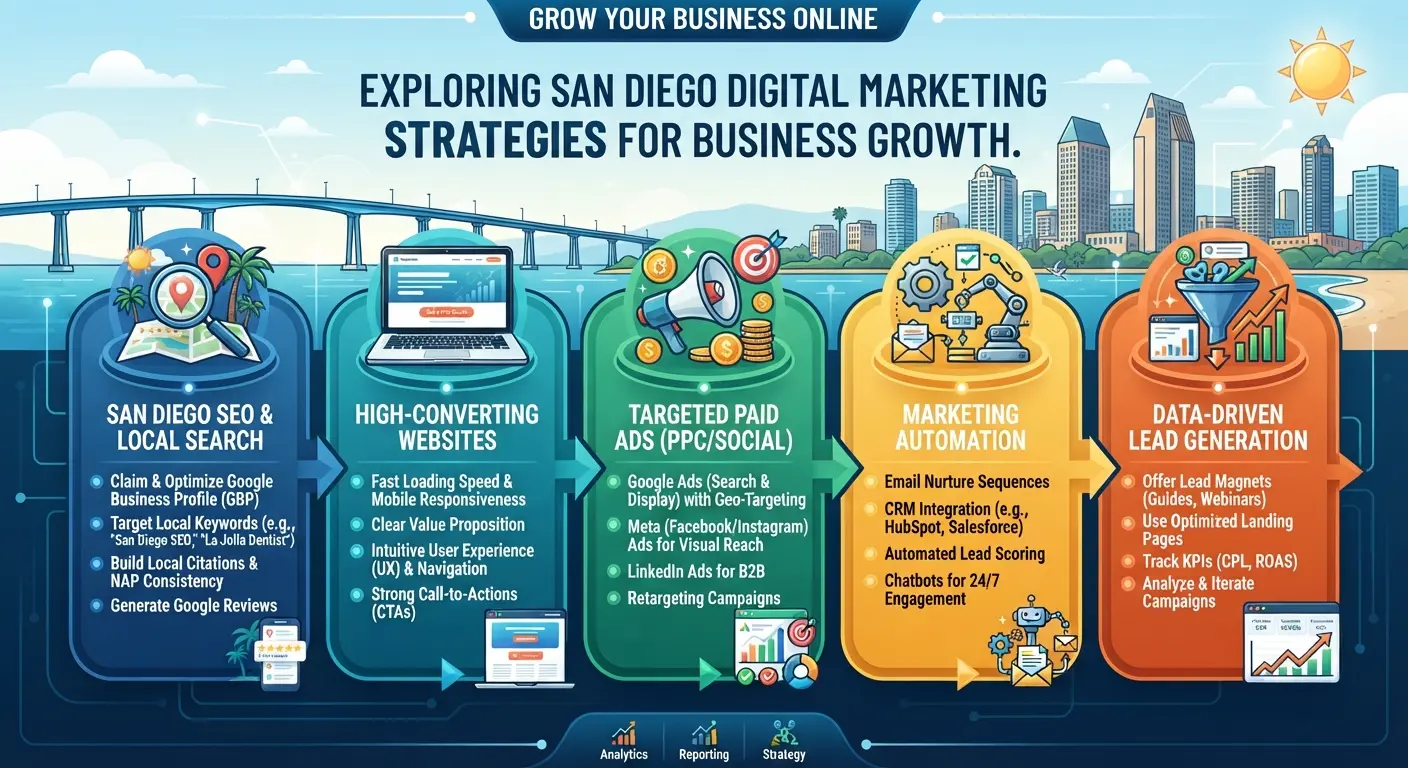
Your Website Is Part of the Marketing Strategy
A website is often the point where marketing attention becomes a business opportunity.
A visitor might arrive through an organic search result, paid advertisement, social media post, referral, or direct visit. Once they arrive, the website needs to help them understand what the business offers and what action they should take.
A conversion-focused website should make important information easy to find.
That can include:
- Clear service descriptions
- Strong calls to action
- Easy navigation
- Mobile-friendly design
- Trust-building information
- Useful educational content
- Simple contact or booking processes
- Fast and accessible user experiences
Website design should therefore support business objectives rather than simply look attractive.
For many companies, the website is effectively a salesperson that works around the clock. If the experience is unclear, marketing traffic can be wasted before a prospect ever contacts the business.
Local SEO and Geographic Search Intent
For businesses serving customers in San Diego, local search can be particularly important.
People often include geographic terms when looking for nearby businesses or services. They may search for a service followed by a city, neighborhood, or other local identifier.
A local SEO strategy can help businesses strengthen their visibility for these searches.
Important areas may include:
- Accurate business information
- Local landing pages
- Relevant service content
- Business listings
- Customer reviews
- Local references
- Website optimization
- Clear geographic relevance
The City of San Diego itself provides business resources covering areas such as market research, marketing, entrepreneurship, and business development.
For a local business, understanding the market and understanding the customer are both essential. SEO should support that understanding rather than replace it.
Content Marketing Builds Trust Before the Sale
Not every customer is ready to buy immediately.
Some prospects are researching a problem. Others are comparing solutions. Some may know what they want but are evaluating providers.
Content marketing gives businesses an opportunity to communicate with customers at different stages of the buying journey.
Useful content can include:
- Educational blog posts
- Service guides
- Frequently asked questions
- Case studies
- Industry explanations
- How-to articles
- Comparison resources
- Local market content
The best content answers real questions.
For example, instead of publishing an article simply because a keyword has search volume, a business can create a resource that explains how to choose a digital marketing partner, what services may be useful, how campaigns are measured, and what questions businesses should ask before starting.
This approach can support both search visibility and customer confidence.
Marketing Automation Can Improve Lead Follow-Up
Generating leads is only one part of digital marketing.
The next challenge is following up consistently.
Potential customers may submit a form, send a message, request information, or interact with an advertisement. If the follow-up process depends entirely on manual action, opportunities can be missed.
Marketing automation can help organize this process.
Automation may support:
- Lead notifications
- Email follow-ups
- Appointment reminders
- Customer segmentation
- CRM updates
- Lead qualification
- Re-engagement campaigns
- Reporting
Invade Marketing currently describes CRM, automation, email, SMS, and AI-powered customer engagement among its digital marketing capabilities.
The objective should not be to automate every human interaction. Instead, automation should handle repetitive tasks while allowing teams to focus on meaningful conversations and business decisions.
How to Choose a Digital Marketing Partner
Choosing a marketing partner is an important business decision. Rather than selecting an agency based only on a list of services, businesses should look at how the agency approaches strategy and measurement.
Consider asking:
1. Do they understand your business objective?
Marketing should connect to a real business goal, such as qualified leads, sales, appointments, customer acquisition, or another measurable outcome.
2. Can they connect multiple channels?
SEO, advertising, websites, content, CRM, and automation can work together. A connected approach may be more useful than disconnected campaigns.
3. How do they measure performance?
Look for clear reporting and meaningful metrics. Depending on the campaign, this could include leads, conversion rates, acquisition costs, revenue, or return on advertising spend.
4. Is the strategy customized?
Every business has different customers, offers, competition, resources, and objectives. A strategy should reflect those differences.
5. Is communication clear?
Marketing can become complicated quickly. A good partner should be able to explain what is happening, why it matters, and what the next steps are.
Why an Integrated Approach Can Make a Difference
One of the biggest challenges businesses face is fragmentation.
SEO may be handled by one person. Paid advertising may be handled by another. Website changes may go through a developer. Email may be managed separately. Sales data may sit in a CRM without being connected to campaign reporting.
Each activity can work independently, but the overall system may lack coordination.
An integrated approach brings these activities closer together.
For example:
SEO attracts search traffic → the website converts visitors → the CRM organizes leads → automation supports follow-up → analytics measures performance.
Paid advertising can feed into the same system.
This creates a clearer view of how different marketing activities contribute to the customer journey.
Invade Marketing and a Performance-Focused Approach
Invade Marketing presents itself as a digital marketing agency offering services including Meta Ads, Google Ads, SEO, web development, graphic design, email marketing, software development, branding, CRM and automation, SMS marketing, and app development. Its website also highlights AI-powered customer engagement and lead follow-up capabilities.
For businesses evaluating San Diego digital marketing solutions, this type of integrated service model can be relevant when the goal is to connect advertising, organic visibility, websites, lead management, and customer follow-up.
The right strategy ultimately depends on the company’s goals, audience, industry, and current marketing infrastructure.
Rather than choosing services simply because they are popular, businesses should identify where their customer journey currently has gaps and build the strategy around those opportunities.
Summary
A successful digital marketing strategy is not simply about being visible online.
It is about creating a connected system that helps the right people discover a business, understand its value, take action, and continue through the customer journey.
For San Diego businesses, this can involve a combination of SEO, local search optimization, paid advertising, content, website development, automation, CRM, and performance tracking.
The most useful starting point is to understand what the business needs most.
If organic visibility is weak, SEO may deserve greater attention. If traffic is strong but conversions are low, website and conversion optimization may be more important. If leads are coming in but follow-up is inconsistent, automation and CRM may provide a stronger opportunity.
A thoughtful san diego digital marketing strategy brings these pieces together around measurable business objectives.
For businesses interested in exploring their current digital marketing opportunities, Invade Marketing offers a free consultation.
Frequently Asked Questions
1. What is San Diego digital marketing?
San Diego digital marketing refers to online marketing strategies used to help businesses reach and engage customers in the San Diego market. It can include SEO, paid advertising, websites, content, social media, email, automation, and analytics.
2. Is SEO important for local businesses?
SEO can help businesses become more visible when people search for relevant products and services. Local SEO can also help businesses communicate their geographic relevance to search engines and potential customers.
3. Should a business use SEO and paid advertising together?
They can complement each other. SEO can support long-term organic visibility, while paid advertising can provide targeted exposure for specific campaigns and offers. The right combination depends on business goals and available resources.
4. What should a business measure in digital marketing?
Useful metrics depend on the campaign. Businesses may track qualified leads, conversions, customer acquisition cost, website engagement, sales, revenue, and advertising return. The important part is connecting metrics to actual business objectives.
5. How can a business improve its digital marketing strategy?
Start by identifying the biggest gap in the customer journey. Review search visibility, advertising performance, website conversion, lead follow-up, and reporting. Then prioritize improvements based on business objectives rather than trying to change everything at once.
For additional information about San Diego’s business environment and economic resources, see the City of San Diego Economic Development Department.