
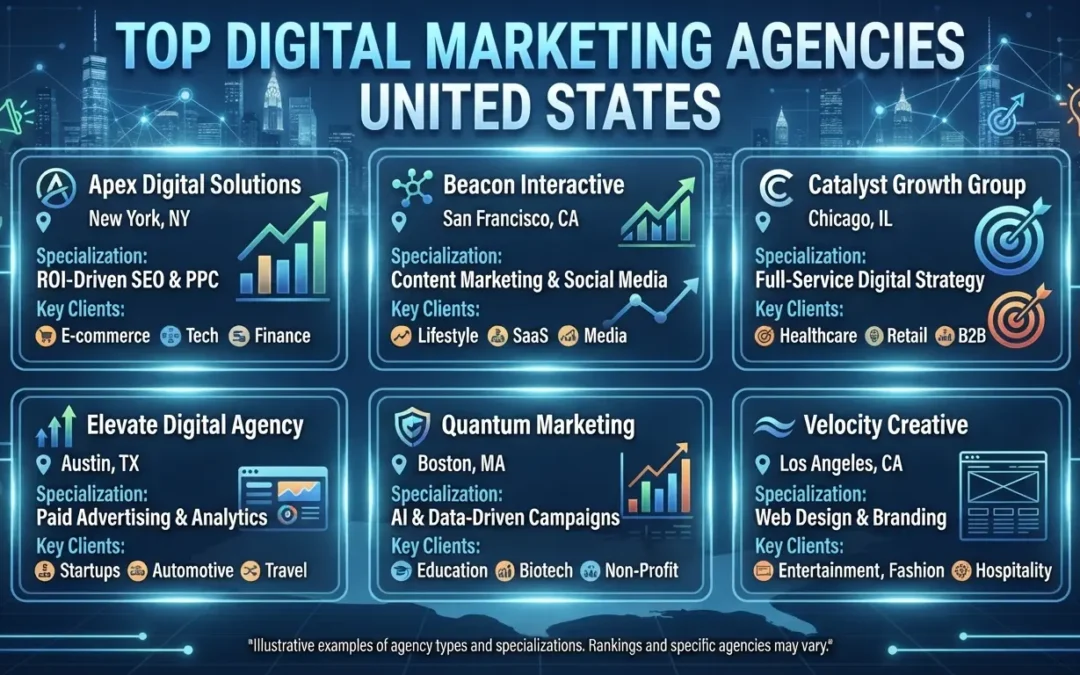
Top Digital Marketing Agencies United States: A Practical Guide for Choosing the Right Partner
Finding the right digital marketing partner can feel overwhelming. There are countless agencies offering services such as search engine optimization, paid advertising, content marketing, social media, web development, and conversion optimization. The challenge is not simply finding an agency that offers these services. It is finding one that understands your business, communicates clearly, and can turn marketing activity into meaningful business results.
For businesses searching for the top digital marketing agencies United States, the best approach is to look beyond rankings and impressive promises. A strong agency should be able to explain what it will do, why it matters, how success will be measured, and how the strategy can adapt as your business grows.
Whether you run a local company, an online business, a professional service firm, or a growing brand, choosing the right marketing partner can have a significant impact on your online visibility and customer acquisition.
What Makes a Digital Marketing Agency a Good Choice?
A good digital marketing agency should do more than create campaigns. It should understand the relationship between your business goals, target customers, website, online visibility, and sales process.
Before choosing an agency, consider whether it can help with these key areas:
- Understanding your target audience
- Building a clear digital marketing strategy
- Improving organic search visibility
- Creating useful and relevant content
- Managing paid advertising campaigns
- Improving website conversions
- Tracking meaningful performance metrics
- Adjusting campaigns based on data
- Communicating progress clearly
The right partner should also be willing to explain its recommendations in language you can understand. You should never feel that complicated terminology is being used to hide a lack of transparency.
Start With Your Business Goals
Before comparing agencies, define what you actually want to accomplish.
Your goal might be to generate more qualified leads, increase online sales, improve search visibility, build brand awareness, reach a new audience, or generate more traffic to an existing website.
Different goals require different strategies.
For example, a company looking for long-term organic visibility may need a strong SEO and content strategy. A business launching a time-sensitive offer may benefit from paid advertising. Another company may need website improvements because visitors are reaching the site but not taking action.
When you know your objectives, it becomes much easier to evaluate agencies.
Instead of asking, “Which agency is the best?” ask:
“Which agency is best suited to solving my specific marketing problem?”
That shift can make the selection process much more productive.
Look at the Agency’s Range of Services
Digital marketing is made up of several connected disciplines. Although you do not necessarily need every service, understanding an agency’s capabilities can help you determine whether it can support your long-term needs.
Common digital marketing services include:
Search Engine Optimization:
SEO helps businesses improve their visibility when potential customers search for relevant products, services, or information.
Content Marketing:
Useful articles, guides, landing pages, videos, and other content can help attract visitors and build trust.
Paid Advertising:
Search and social advertising can help businesses reach specific audiences and generate traffic more quickly.
Social Media Marketing:
Social platforms can support brand awareness, audience engagement, community building, and customer relationships.
Conversion Rate Optimization:
Getting visitors to your website is only part of the process. Conversion optimization focuses on making it easier for visitors to become leads or customers.
Web Design and Development:
A fast, accessible, easy-to-navigate website provides an important foundation for many marketing campaigns.
The strongest strategy often connects several of these areas rather than treating each channel as completely separate.
Don’t Choose an Agency Based Only on Its Ranking
When searching for the top digital marketing agencies United States, you may find lists, directories, reviews, and articles that rank agencies differently.
These lists can be useful for discovering potential partners, but they should not be your only decision-making tool.
An agency appearing at the top of a list does not automatically mean it is the right fit for your company.
Look at factors such as:
- Relevant experience
- Communication style
- Strategic approach
- Service capabilities
- Reporting process
- Understanding of your industry
- Ability to explain its methods
- Alignment with your business goals
A smaller agency may be an excellent fit for one business, while a larger agency may be better suited to another.
The goal is not to find the agency with the biggest reputation. The goal is to find the partner that can provide the right strategy and execution for your needs.
Evaluate the Agency’s SEO Approach
SEO can be one of the most valuable long-term marketing channels, but it requires patience and consistent effort.
When discussing SEO with a potential agency, ask how it approaches keyword research, content, technical improvements, internal linking, website structure, and performance measurement.
A credible agency should be able to discuss SEO as a long-term process rather than promising instant results.
Be cautious of guarantees such as:
- Instant first-page rankings
- Guaranteed traffic increases
- Guaranteed sales
- Overnight SEO results
Search visibility depends on many factors, including competition, website quality, search intent, content relevance, technical performance, and changes in search behavior.
A professional strategy should focus on sustainable improvements rather than shortcuts.
Ask How Success Will Be Measured
Marketing reports can contain dozens of numbers, but not every number matters equally.
Website traffic, impressions, clicks, engagement, leads, conversion rates, and revenue can all provide useful information. However, the most important metrics depend on your business objectives.
For example, if your main goal is lead generation, you should care about qualified leads rather than traffic alone.
If your goal is ecommerce growth, revenue, conversion rate, and customer acquisition costs may be more meaningful.
Ask potential agencies:
- What metrics will you track?
- How frequently will you report results?
- How will you define success?
- Which metrics directly connect to business outcomes?
- How will the strategy change if performance is below expectations?
A good agency should be comfortable discussing both successful results and areas that need improvement.
Consider Communication and Transparency
A marketing strategy can be technically excellent and still fail if communication is poor.
You should know who is responsible for your account, how often you will receive updates, and how you can ask questions.
Look for an agency that provides clear communication about:
- Campaign progress
- Completed work
- Upcoming priorities
- Challenges
- Opportunities
- Performance
- Strategic recommendations
Transparency also matters when discussing advertising budgets, campaign changes, content production, and other marketing activities.
You should understand what your agency is doing and why.
Review Case Studies Carefully
Case studies can provide useful insight into how an agency approaches real-world marketing challenges.
However, don’t only look at the final numbers. Pay attention to the story behind the result.
Ask:
What was the original problem?
What strategy was implemented?
What work was completed?
How was success measured?
What changed over time?
This can tell you much more about an agency’s capabilities than a simple list of impressive statistics.
Also consider whether the case study is relevant to your situation. Results from one industry or business model may not translate directly to another.
Think About Your Target Audience
Marketing is most effective when it starts with the customer.
Your agency should understand who you want to reach, what those people need, what questions they ask, and what influences their buying decisions.
This is especially important for SEO and content marketing.
A keyword may have high search volume but little commercial value for your business. Another keyword may have a smaller audience but attract people who are much closer to making a purchase.
Effective marketing focuses on search intent and customer needs, not simply the number of searches.
Make Sure the Website Supports Marketing
Even an excellent marketing campaign can struggle if the website creates friction.
Visitors may leave if a website is difficult to navigate, slow to load, confusing, outdated, or unclear about what the business offers.
Your digital marketing partner should consider the complete customer journey.
That means looking at what happens after someone clicks an advertisement or finds your website through search.
Can they quickly understand the offer?
Can they find the information they need?
Is the next step obvious?
Is it easy to contact the business?
These questions are important because successful digital marketing is not just about attracting visitors. It is about helping the right visitors take meaningful action.
Look for a Long-Term Strategic Partner
Digital marketing is constantly changing.
Search behavior evolves. Advertising platforms update their systems. Customers change how they research products and services. New technologies influence how people discover information.
For this reason, your marketing strategy should not remain completely static.
The agency you choose should be willing to test, analyze, learn, and adjust.
A good long-term partner should help you identify opportunities instead of simply completing a predetermined list of tasks every month.
This strategic mindset can be particularly valuable for businesses that want sustainable growth rather than short-term spikes in traffic.
Questions to Ask Before Hiring an Agency
Before signing an agreement, prepare a list of practical questions.
Consider asking:
- What would your initial strategy look like for my business?
- Which marketing channels would you prioritize?
- How would you identify my target audience?
- How do you measure campaign performance?
- What type of reporting should I expect?
- Who will manage my account?
- How will communication work?
- How do you approach SEO and content?
- How do you handle underperforming campaigns?
- What information do you need from my team?
The answers can reveal whether the agency is genuinely interested in understanding your business or simply trying to close a sale.
Why the Right Fit Matters More Than the Biggest Name
Choosing among the top digital marketing agencies United States should ultimately come down to fit.
A successful partnership requires trust, communication, realistic expectations, and a shared understanding of your objectives.
You want a marketing team that can work with your business rather than simply applying a generic strategy.
The right agency should be able to identify where your business is today, understand where you want to go, and create a practical path between those two points.
That may include improving your website, strengthening organic visibility, developing content, managing advertising, or connecting multiple channels into one cohesive strategy.
Choosing Your Next Marketing Partner
The search for a digital marketing agency does not have to be complicated.
Start by defining your goals. Then compare agencies based on their experience, services, communication, strategic thinking, reporting, and ability to understand your audience.
Most importantly, don’t choose based solely on a ranking, a flashy website, or promises of extraordinary results.
Look for a partner that can explain its approach clearly and connect marketing activities to real business objectives.
For businesses ready to explore their options, Invade Marketing provides a starting point for learning more about digital marketing support. If you want to discuss your business goals and potential next steps, you can also request a free consultation.
The best marketing partnership is not necessarily the one with the most services or the biggest claims. It is the one that understands your business, communicates honestly, measures what matters, and builds a strategy designed around your customers and long-term growth.