
Choosing the right partner for multi-market growth is one of the most important decisions a Fortune 1000 brand can make. When your organization operates across regions, languages, and regulatory environments, the marketing agency you select must do more than generate traffic. It must protect and strengthen your reputation while carefully acquiring the links that support long-term authority.
This guide walks you through a clear, practical way to evaluate multi-market marketing agencies that balance reputation management with link acquisition. The goal is to help thoughtful leaders feel confident they are selecting a partner who understands both the visibility side of search and the trust side of brand perception.
Why the Balance Matters for Large Brands
Fortune 1000 companies live in a complex digital environment. Search engines, AI systems, industry publications, and customers all form impressions based on what appears online. Reputation management involves deliberately shaping how your brand is perceived across those surfaces. Link acquisition, when done ethically and strategically, contributes to that same perception by earning editorial endorsements from trusted sources.
When these two areas are treated as separate workstreams, problems appear. Aggressive link tactics can create risk. Reputation efforts that ignore search visibility leave opportunity on the table. The strongest multi-market agencies treat them as connected disciplines. They understand that a high-quality link from a respected publication does more than pass authority. It also places your brand in a positive narrative context that supports trust.
According to the established understanding of the practice, reputation management is the deliberate influence, control, enhancement, or concealment of an individual’s or group’s reputation, and online reputation management focuses on overseeing and influencing the search results related to products and services.
Agencies that grasp this connection are better equipped to serve organizations that cannot afford short-term ranking gains at the expense of long-term brand equity.
Key Criteria for Evaluating Multi-Market Agencies
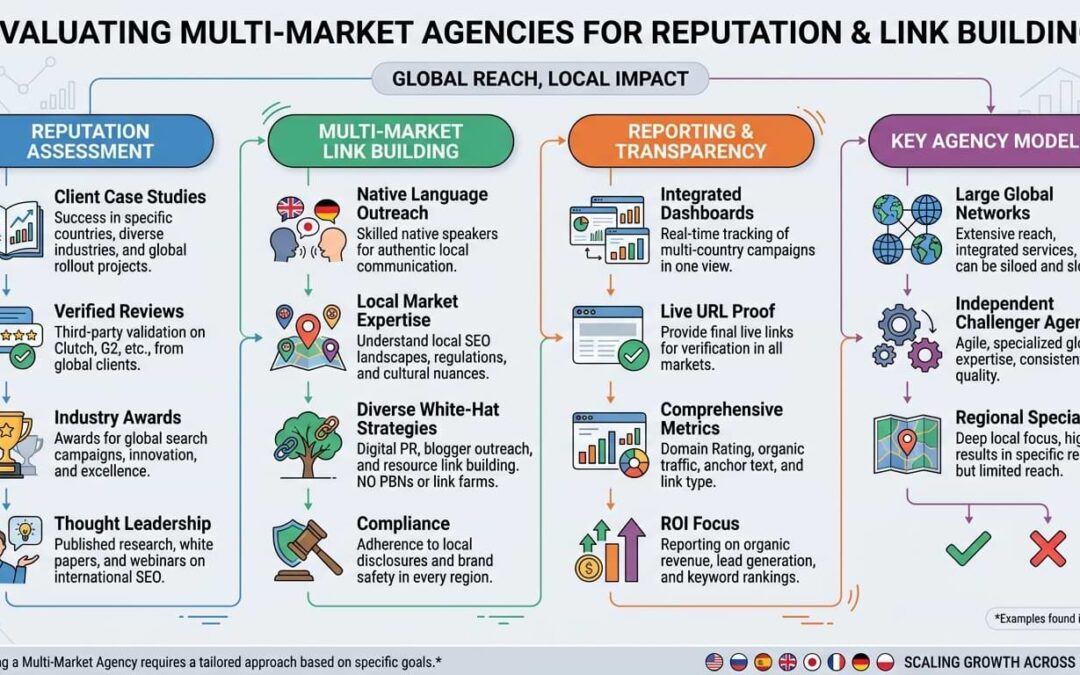
Start with experience that matches the scale and complexity of Fortune 1000 operations. Ask how the agency has coordinated campaigns across multiple markets. Look for evidence of work that required alignment between global brand guidelines and local execution. Multi-market success depends on the ability to maintain consistent messaging while adapting to cultural, legal, and search-engine differences.
Next, examine how the agency approaches reputation management. Effective partners monitor brand mentions, review landscapes, and search results continuously. They respond thoughtfully rather than reactively. They also understand that content and outreach decisions affect what appears when someone searches for your company name or key executives.
Then evaluate the link acquisition approach. The best agencies prioritize editorial quality, topical relevance, and natural placement over volume. They can explain how they select publishers, how they maintain brand safety, and how they measure the contribution of links to both rankings and perception. They avoid methods that could create future risk for a highly visible brand.
Transparency and reporting form another essential criterion. You should expect clear visibility into publisher selection, placement details, and the connection between activity and outcomes. Fortune 1000 teams need reporting that supports internal governance and board-level conversations. Vague dashboards or vanity metrics are not enough.
Finally, assess cultural and operational fit. Does the agency communicate calmly and clearly? Do they ask thoughtful questions about your risk tolerance, approval processes, and long-term goals? A partner who rushes toward activity without understanding your constraints is unlikely to succeed in a complex environment.
How Reputation Management and Link Acquisition Work Together
In practice, the strongest programs integrate the two. Link acquisition becomes a reputation tool when placements appear on sites that your audience already trusts. A thoughtful article on an industry publication does more than earn a link. It associates your brand with expertise and reliability. Over time, these associations shape both search results and the broader conversation about your company.
Reputation management, in turn, creates the foundation that makes high-quality link acquisition easier. Brands with clear, consistent messaging and strong owned content give publishers better reasons to engage. Agencies that understand this relationship invest in content that is genuinely useful rather than purely promotional.
For multi-market brands, this integration must respect regional differences. A placement that strengthens reputation in one market may need careful adaptation or different framing in another. Agencies experienced in multi-market work build processes that account for these nuances without slowing progress to a halt.
Practical Steps to Assess Potential Partners
Begin with a structured conversation. Share your current challenges around visibility, perception, and multi-market coordination. Listen carefully to how the agency responds. Do they ask clarifying questions? Do they describe a process that balances speed with caution?
Request examples of how they have balanced the two disciplines for organizations of similar scale. You do not need confidential client details. You do need to hear concrete thinking about risk, quality, and measurement.
Review their approach to governance. Fortune 1000 brands typically have legal, brand, and regional stakeholders who must approve certain activities. An agency that has already built workflows for multi-stakeholder review will move more smoothly than one that treats approvals as an afterthought.
Examine measurement philosophy. The most useful partners connect link and reputation activity to outcomes that matter to leadership: qualified demand, reduced risk of negative visibility, stronger branded search performance, and improved share of voice in key conversations.
Consider how they handle content. High-quality link acquisition and reputation work both depend on material that earns attention for the right reasons. Agencies that treat content as a strategic asset rather than a volume exercise tend to produce more durable results.
Common Pitfalls to Avoid
One frequent mistake is selecting an agency solely on the basis of promised link volume. Volume without quality or relevance rarely serves a Fortune 1000 brand well. Another is treating reputation management as purely defensive. While protecting against negative coverage is important, the stronger long-term approach includes proactive narrative building.
A third pitfall is underestimating the coordination required across markets. Agencies that have primarily served single-market clients may struggle with the complexity of global brand guidelines, local search behavior, and regional compliance needs.
Finally, be cautious of partners who cannot clearly articulate how their work supports both visibility and trust. The two outcomes are connected. An agency that speaks only about rankings or only about crisis response is less likely to deliver the balanced results large brands need.
Building a Productive Partnership
Once you have selected a partner, set clear expectations from the beginning. Define success in terms that include both measurable search progress and qualitative reputation outcomes. Establish regular review points that allow both sides to adjust based on results and changing market conditions.
Maintain open communication. Multi-market programs surface unexpected issues. A calm, collaborative working style helps teams resolve those issues without unnecessary friction.
Invest in the relationship. The best results come when the agency understands your brand deeply enough to make good decisions in real time. Share context, provide timely feedback, and treat the partnership as a long-term collaboration rather than a series of transactions.
Summary
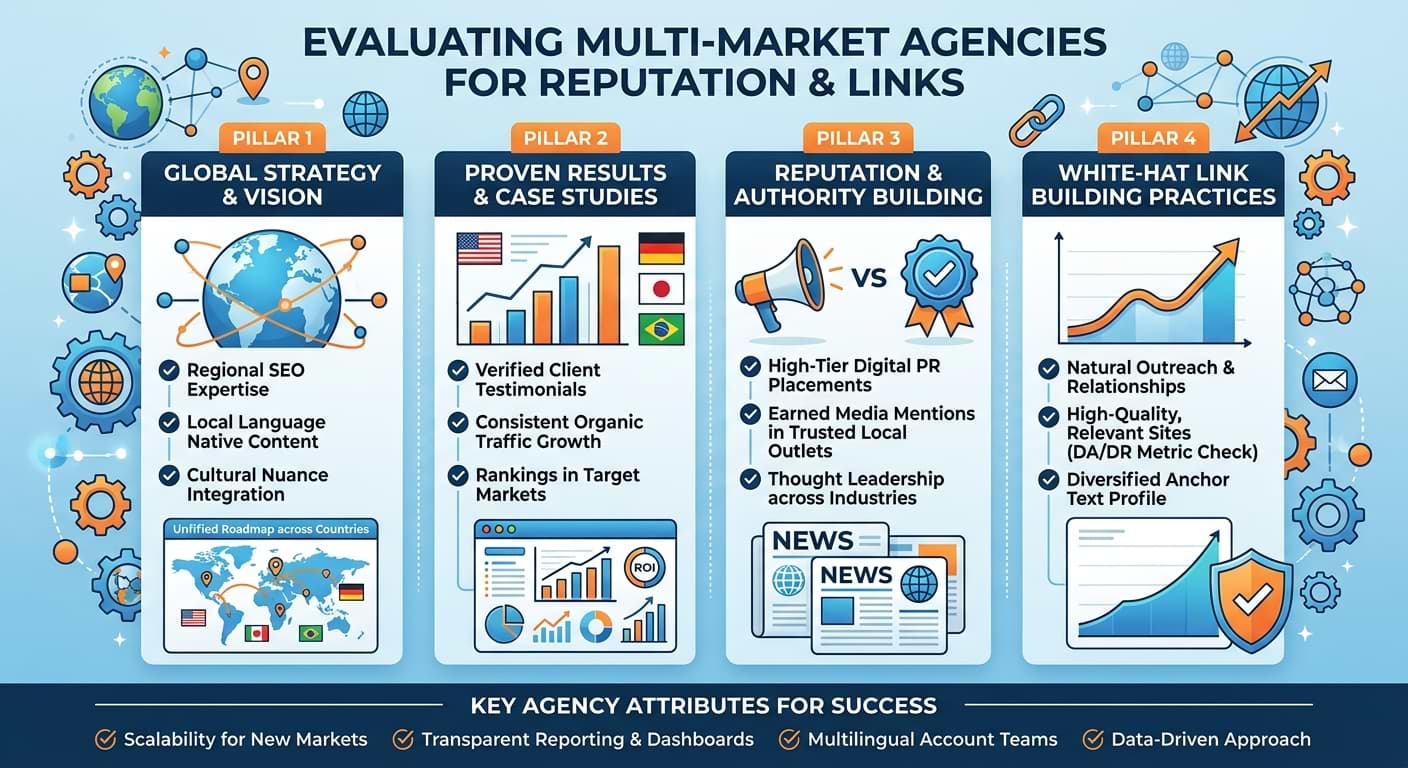
Evaluating multi-market marketing agencies that balance reputation management with link acquisition requires a thoughtful, structured approach. Focus on relevant experience, integrated thinking, transparency, governance readiness, and cultural fit. Look for partners who treat high-quality links as both ranking assets and reputation signals. Avoid volume-focused or purely reactive approaches.
When these elements are in place, Fortune 1000 brands gain a partner capable of supporting sustainable visibility and trust across markets. The result is marketing that strengthens the organization rather than creating future risk.
If your team is ready to explore how a results-focused partner approaches multi-market growth with care for both reputation and authority, we invite you to start a conversation.
Related Questions and Answers
1. Why is balancing reputation management and link acquisition especially important for Fortune 1000 brands?
Large brands face higher scrutiny and greater potential impact from any digital activity. A balanced approach protects long-term trust while still building the authority signals that support visibility in competitive search environments.
2. What should multi-market agencies demonstrate regarding regional differences?
They should show experience adapting strategy and content to local search behavior, cultural norms, and regulatory requirements while maintaining consistent global brand standards.
3. How can leaders assess the quality of an agency’s link acquisition methods?
Ask about publisher selection criteria, brand-safety processes, relevance standards, and how placements are measured beyond simple domain metrics. Quality-focused agencies emphasize editorial context and long-term value.
4. What role does content play in this combined approach?
Strong content serves as the foundation for both reputation and link efforts. Useful, well-researched material gives publishers a genuine reason to engage and helps shape positive perceptions across search and media.
5. How does reporting differ for these sophisticated programs?
Effective reporting connects activity to outcomes that leadership cares about, including visibility trends, narrative presence, risk indicators, and contribution to broader business goals, rather than relying solely on volume or ranking screenshots.