
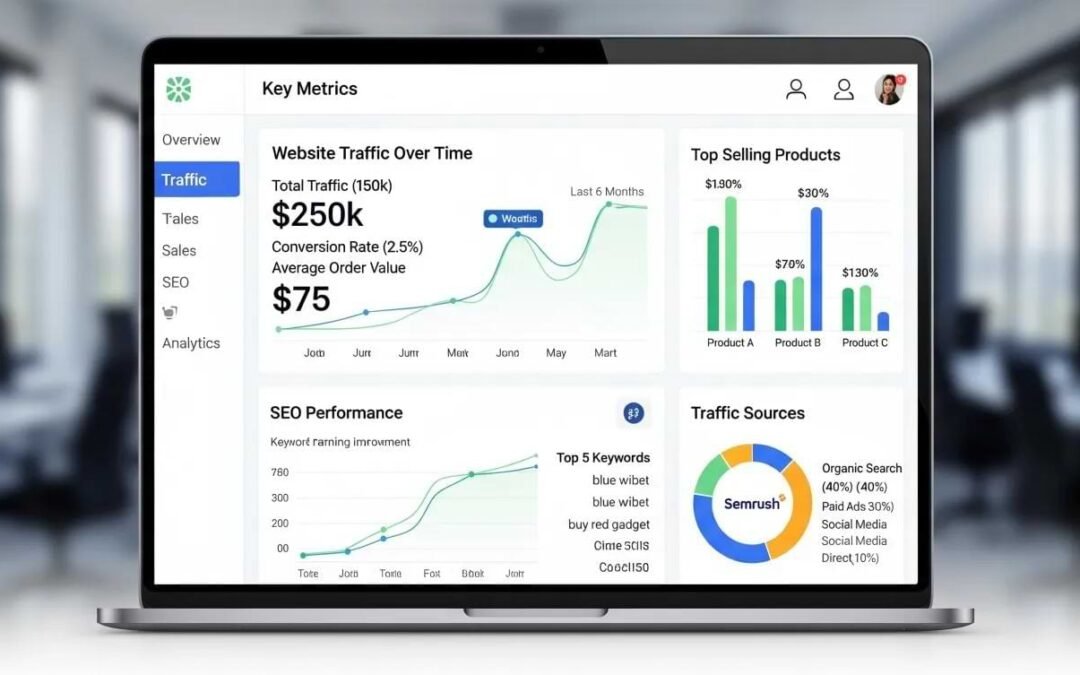
The Best Full-Service Digital Marketing Agencies for Ecommerce SEO 2026 refers to agencies that combine technical SEO, paid media, content strategy, conversion optimization, and AI search visibility into a single, integrated growth system for online stores. A full-service ecommerce SEO agency is one that manages the entire organic and paid acquisition funnel, from site architecture and structured data to link building and performance reporting. These agencies are distinguished by their ability to connect ad spend and search rankings directly to measurable revenue outcomes for ecommerce brands.
Every year, thousands of online store owners run the same experiment: they invest in ads, watch their cost per acquisition climb, and wonder why organic traffic never seems to catch up. The answer is almost always a strategy problem, not a budget problem.
In 2026, organic search still drives 43% of all ecommerce traffic, and the channel delivers a 317% ROI with a nine-month break-even window, according to industry benchmarks compiled by Shopify’s ecommerce research team. No paid channel comes close to that long-term compounding return. But capturing it requires more than keywords and content. It requires a full-service partner built specifically for ecommerce.
This guide breaks down what to look for in a top-tier agency, which services matter most in 2026, and how to evaluate whether an agency is genuinely built for ecommerce growth or just adapts general marketing services to online retail.
What “Full-Service” Actually Means for Ecommerce SEO in 2026
The term “full-service” is used broadly, but in the context of ecommerce SEO it carries a specific meaning. A genuinely full-service agency does not operate in silos. It does not have one team running your paid ads while a separate team handles your SEO with no shared strategy between them.
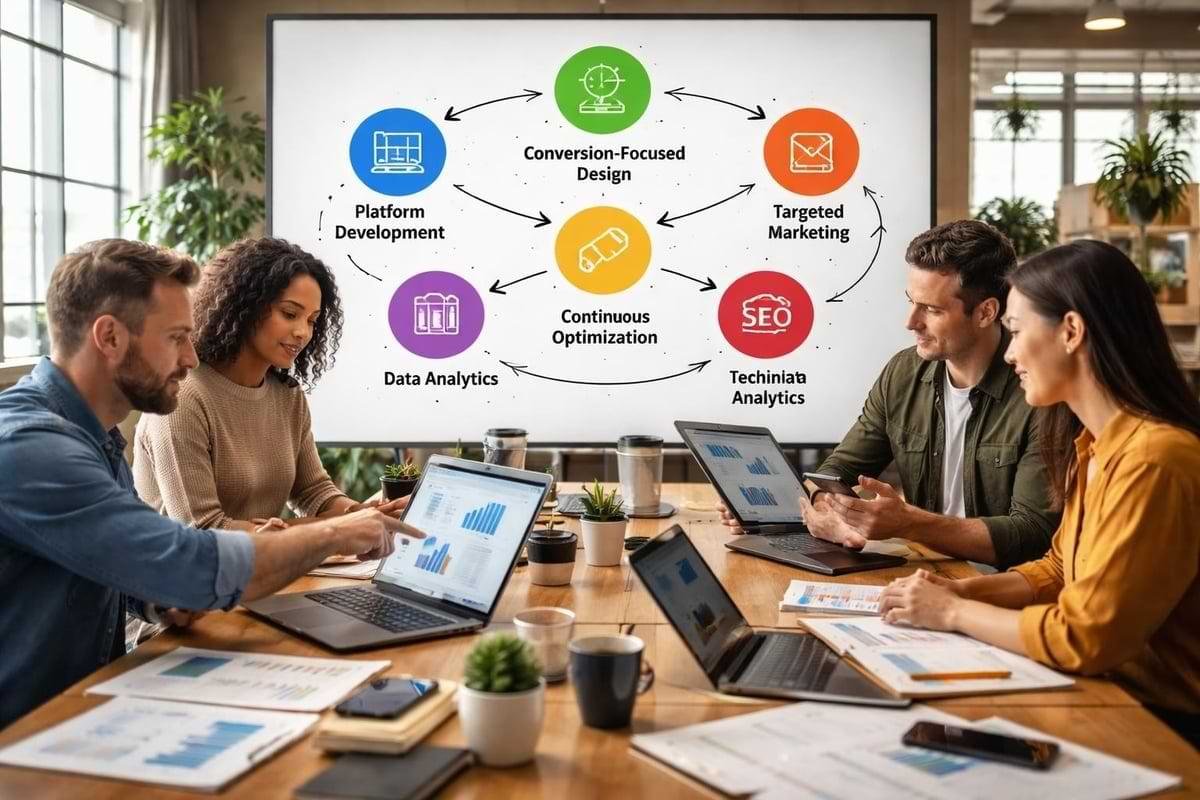
In 2026, a full-service ecommerce SEO agency integrates the following disciplines under a unified growth strategy:
- Technical SEO: Crawl architecture, structured data (schema markup), Core Web Vitals, faceted navigation management, and platform-specific optimization for Shopify, WooCommerce, Magento, or BigCommerce
- Content and On-Page SEO: Category page optimization, product description strategy, buyer-intent content, and internal linking frameworks
- Link Building and Digital PR: Earning high-authority backlinks through editorial placements, data-driven content, and brand mentions
- Paid Media: Google Shopping, Performance Max, Meta ads, and retargeting campaigns that complement organic strategy
- Conversion Rate Optimization (CRO): Landing page testing, checkout friction reduction, and product page performance improvements
- AI Search Visibility: Optimization for Google AI Overviews, generative engine optimization (GEO), and structured content that earns citations in AI-generated answers
The agencies that deliver the strongest results in 2026 treat these not as separate services but as connected levers in a single revenue engine.
Why Ecommerce SEO Demands a Specialist, Not a Generalist

General digital marketing agencies serve many client types. They typically apply the same strategic framework across B2B, local services, professional services, and ecommerce. The problem is that ecommerce SEO has unique technical and structural requirements that a generalist approach consistently misses.
Consider the scale alone. The average ecommerce brand ranks for approximately 1,783 organic keywords generating around 9,625 monthly organic visits. Enterprise catalogs with thousands of product SKUs, dynamic faceted navigation, and frequent inventory changes require a different operational approach than a service business blog.
Specialist agencies understand:
| Challenge | Why It’s Unique to Ecommerce |
|---|---|
| Faceted navigation | Creates crawl traps and duplicate content without proper handling |
| Product schema | Price, availability, and review markup directly affects Google Shopping visibility |
| Catalog depth | Thousands of pages require programmatic SEO frameworks, not page-by-page optimization |
| Platform constraints | Shopify, Magento, and WooCommerce each have distinct technical SEO limitations |
| Seasonal demand | Organic traffic planning must account for inventory cycles and peak periods |
| AI Overview impact | Only 3.2% of shopping queries trigger AI Overviews, presenting a lower disruption risk than informational verticals |
When evaluating the best full-service digital marketing agencies for ecommerce SEO, a specialist track record in the above areas is a prerequisite, not a bonus.
The Seven Core Services That Define a Top Ecommerce SEO Agency in 2026
1. Technical SEO Infrastructure
This is the foundation. Before any content or link-building effort pays off, the site must be technically sound. Leading agencies begin every ecommerce engagement with a full technical audit covering crawlability, indexation, site speed, structured data implementation, and mobile performance. Mobile devices now account for 75% of all ecommerce traffic, and pages with schema markup achieve 20 to 40% higher click-through rates. These are not optional improvements.
2. Ecommerce Platform Expertise
The agency should have demonstrated experience on your specific platform. Strategy that works on Shopify may not translate directly to Magento. Top agencies maintain certified expertise on the major platforms and understand the default technical limitations of each.
3. Category and Product Page Optimization
Category pages, not product pages, drive the majority of organic ecommerce revenue for most stores. A skilled agency builds these pages around high-intent buyer keywords, optimizes heading structures, and deploys internal linking strategies that reinforce the authority of commercial pages across the entire catalog.
4. Content at Scale
The best full-service digital marketing agencies for ecommerce SEO 2026 build content engines, not one-off blog posts. They develop topical authority frameworks that capture the full search journey, from discovery-stage informational content to high-intent buying guides that convert.
5. Link Acquisition and Digital PR
Authority still matters. Top pages on Google Search have an average of 3.8 times more backlinks than lower-ranked results. Agencies that earn high-authority backlinks through data-led content and editorial placements provide a compounding advantage that is difficult for competitors to replicate quickly.
6. Paid Media Integration
Organic and paid search are not competing strategies. The most effective ecommerce growth programs use paid media to capture demand that organic has not yet reached, while using organic data to improve paid targeting. Agencies that manage both under one strategy eliminate the attribution confusion that comes from running them separately.
7. Reporting Tied to Revenue
Any agency can report on traffic and rankings. The best ones connect every metric to revenue. They track organic revenue contribution by channel, attribute sales to specific content investments, and present data in a format that connects marketing activity directly to business outcomes.
For brands evaluating agencies across multiple markets, the Invade Marketing agency network provides regional performance insights that help identify the right local partner for your growth stage.
How to Evaluate and Compare Agencies: A Practical Framework
The volume of agencies claiming ecommerce SEO expertise has grown significantly. The framework below helps cut through the noise.
Questions to Ask Before Signing
1. Can you show ecommerce-specific case studies with revenue impact? Traffic growth without revenue attribution is a yellow flag. Ask for case studies that include organic revenue, cost per acquisition from organic channels, and conversion rate benchmarks.
2. What platforms do your technical SEO team certify in? Shopify, Magento, BigCommerce, and WooCommerce each have distinct SEO behaviors. Certification matters.
3. How do you approach AI search visibility in 2026? Brands cited in AI Overviews see up to 35% more organic clicks. If the agency has no methodology for generative engine optimization, they are building for a search environment that no longer fully exists.
4. Who owns the assets when the engagement ends? Your ad account, pixel, content, and analytics access should belong to your business, not the agency.
5. How is strategy communicated and how often? Look for weekly performance reviews, monthly strategy sessions, and clear escalation paths. Opacity in reporting is a consistent early warning sign.
What to Budget for Full-Service Ecommerce SEO in 2026
Pricing varies significantly based on catalog size, competitive landscape, and service scope. The table below provides a realistic range for Canadian and North American brands.
| Service Tier | Monthly Investment | Best For |
|---|---|---|
| Starter | $2,500 to $5,000 CAD | Small ecommerce stores, single-platform focus |
| Growth | $5,000 to $12,000 CAD | Multi-category stores scaling organic revenue |
| Enterprise | $12,000 CAD and above | Large catalogs, multi-market, full-channel integration |
These figures represent agency management fees. Paid media budgets and content production costs are typically separate line items. Brands that track long-term ROI consistently find that ecommerce SEO delivers higher compounding returns than paid channels alone, with a break-even window of approximately nine months.
Businesses searching for a best digital marketing agency for higher education or verticals beyond retail will find similar ROI dynamics apply across sectors, particularly where content and authority drive buyer decisions over time.
The 2026 Differentiator: AI Search Optimization
The single biggest strategic shift for ecommerce SEO in 2026 is the integration of AI search visibility into core agency deliverables. According to HubSpot’s State of Marketing 2026, 78 to 88% of marketers now use AI tools in their daily workflow, and AI-driven campaigns deliver 22% higher ROI with 32% more conversions.
For ecommerce brands, this means:
- Product pages must be structured for AI citation, not just traditional ranking signals
- FAQ and schema markup are now table stakes for generative engine visibility
- Content written for human readers and AI parsers simultaneously performs better across both traditional and AI-generated search surfaces
Agencies still treating AI as a tool for writing content rather than a search environment to optimize for are already behind.
Choosing a Partner That Fits Your Business
The best agency for your business is not necessarily the largest or the most decorated. It is the one whose operational model, communication style, reporting framework, and sector experience align with your growth stage and internal capabilities.
For growing brands searching for a best digital marketing agencies near me with both local accountability and global platform expertise, the most important filter is always demonstrated ecommerce revenue impact, not award counts or client logo lists.
Equally, for brands in emerging markets, access to regionally specialized teams matters. Whether looking for the best digital marketing agency in lucknow or a global delivery model, the structural requirements of strong ecommerce SEO remain consistent: technical depth, content authority, and a direct line between organic investment and revenue.
FAQ
What makes a digital marketing agency “full-service” for ecommerce SEO?
A full-service ecommerce SEO agency integrates technical SEO, content strategy, paid media, link building, CRO, and AI search optimization under a single unified strategy. It manages the complete acquisition funnel rather than treating each channel as an isolated deliverable.
How long does ecommerce SEO take to show results?
Most ecommerce SEO programs require 30 to 60 days for technical improvements to be indexed, and 6 to 12 months to see meaningful organic revenue growth. The channel delivers compounding returns over time, with SEO delivering an average 8x ROI over a 36-month period.
How do I know if an ecommerce SEO agency is right for my business?
Ask for ecommerce-specific case studies with revenue impact, confirm the agency has certified platform expertise on your specific stack, and verify that their reporting connects organic activity directly to sales data rather than stopping at traffic metrics.
What is the difference between ecommerce SEO and general SEO?
Ecommerce SEO addresses unique challenges including large-scale catalog management, faceted navigation, product and category schema, platform-specific technical constraints, and seasonal demand planning. These requirements are significantly different from the content-led approaches that work for service businesses or publishers.
Should ecommerce brands use SEO or paid ads?
Both serve important roles. Paid media captures immediate demand and generates data quickly. Organic SEO builds a compounding asset that drives traffic and revenue without ongoing cost per click. The most effective ecommerce growth programs integrate both under a unified strategy. Organic search delivers 317% ROI with a nine-month break-even, making it the stronger long-term investment for most brands.
Ready to Find the Right Ecommerce Growth Partner?
The difference between an ecommerce store growing predictably and one stuck in a paid-ad cycle almost always comes down to organic strategy. The best full-service digital marketing agencies for ecommerce SEO in 2026 do not just run campaigns. They build revenue-generating systems that compound over time.
At Invade Marketing, we work with brands that are ready to stop relying entirely on ad spend and start building organic equity that works around the clock. If your ecommerce store is ready for a strategy built around measurable revenue growth rather than vanity metrics, the next step is a conversation.
Book your free consultation today and get a clear picture of where your ecommerce SEO currently stands and exactly what it would take to grow it.